
When to Use an Open Printer, an Enclosure, or a Heated Chamber (And Why It Depends on the Plastic)
The biggest mistake people make is thinking printer type comes first. It doesn’t.
The plastic comes first. The printer setup is just there to support the physics of that material.
Every plastic shrinks when it cools. The hotter the plastic prints, the more it shrinks. If cooling happens unevenly, internal stress builds up. That stress becomes warping, cracking, and weak layer bonding. Everything about open printers, enclosures, and heated chambers exists to control how that cooling happens.
The question is not “Which printer is better?”
The question is “How sensitive is this plastic to temperature changes?”
For low-temperature plastics, an open printer is completely fine.
PLA, PETG, and TPU simply do not generate enough thermal stress to justify enclosure or chamber heating. They print at lower nozzle temperatures, shrink very little, and cool evenly in normal room air. An open printer is cheaper, simpler, faster to work with, and already delivers excellent results.
If you mostly print:
PLA
PETG
TPU
Then an open printer is not a compromise. It is the correct tool.
Things change when you step into higher-temperature polymers.
ABS and ASA are where an enclosure starts to matter. These materials shrink much more and hate cold air. Drafts, open rooms, or uneven cooling will cause warping and layer separation. But they usually do not need an actively heated chamber. What they need is a stable environment.
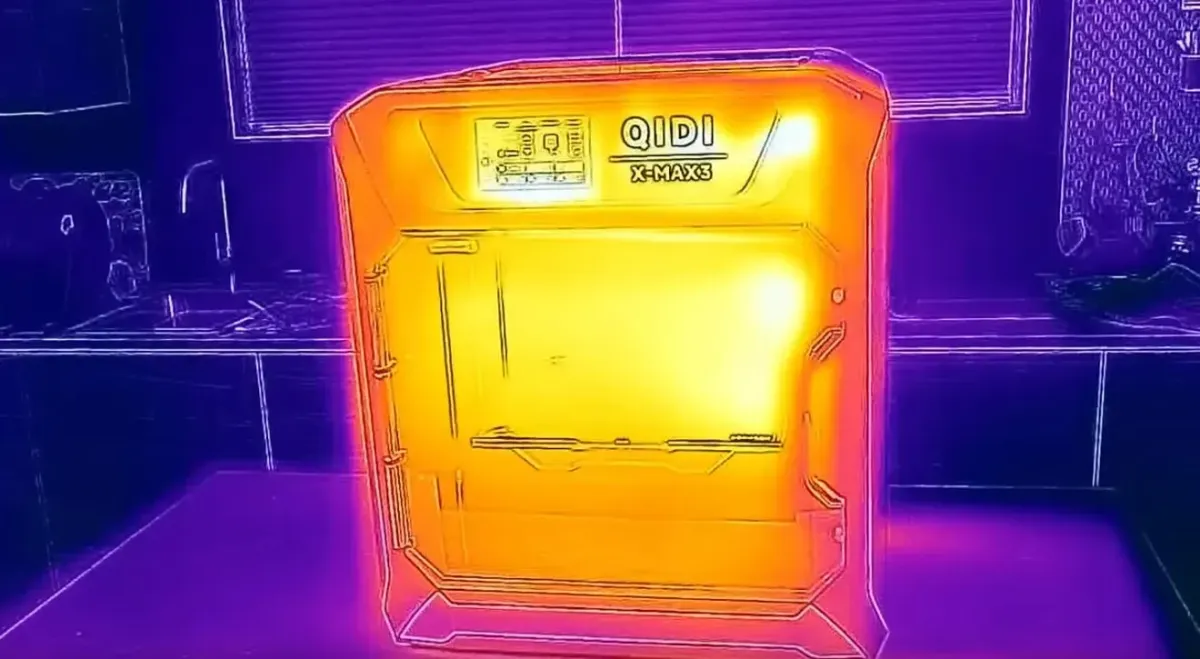
An enclosure traps the heat from the bed and hotend and raises the air temperature naturally. That passive warming is usually enough to keep ABS and ASA stable. The key is not hitting a specific chamber temperature, it is eliminating cold airflow and sudden temperature drops.
For ABS and ASA:
An enclosure is the requirement.
A heated chamber is optional.
Nylon moves you closer to true chamber heating.
It shrinks more, bonds better when warm, and loses mechanical performance if the ambient temperature drops too fast. An enclosure helps, but for consistent strength and dimensional accuracy, active chamber heating becomes valuable. This is where a heated chamber starts making practical sense.
Polycarbonate is even more demanding.
It prints extremely hot and shrinks aggressively. Layer adhesion depends heavily on ambient temperature. At this point, a simple enclosure often isn’t enough. A heated chamber becomes close to mandatory for reliable results.
PEEK and PEI are in a completely different category.
These are industrial polymers that require:
Very high nozzle temperatures
Very hot beds
And a strictly controlled heated chamber
Without active chamber heating, printing them is not realistic in any reliable way.
So the real decision structure looks like this:
Open printer
For materials that barely care about thermal stability.
PLA, PETG, TPU.
Enclosed printer
For materials that need stability but not strict temperature control.
ABS, ASA.
Heated chamber
For materials that need controlled ambient temperature.
Nylon, Polycarbonate, PEI, PEEK.
This is why a heated chamber is not an upgrade path.
It is not “better”.
It is more specialized.
If your parts are cosmetic, prototypes, housings, or light mechanical components made from PLA, PETG, or TPU, an open printer is exactly what you want.
If your parts are structural, outdoors exposed, or need the properties of ABS or ASA, then an enclosure becomes the smart investment.
If your parts require real engineering plastics like Nylon, PC, or anything above that, a heated chamber stops being optional and starts being mandatory.
The printer should always be chosen to serve the material.
Not the material chosen to match the printer.
If you are unsure which material or printer setup fits your part, that is exactly what we help with.
We work with open, enclosed, and heated-chamber capable systems depending on what your application actually needs.
You don’t have to guess. You just upload your file.
Upload your model, select your material, and get a real quote for your part in minutes.