Where FDM 3D Printing Actually Makes Sense in the B2B World
FDM 3D printing is often dismissed as “just for prototypes”. That mindset leaves a lot of value on the table. In B2B manufacturing, FDM is not about replacing CNC or injection molding. It is about solving problems faster, cheaper, and with less risk when traditional methods are slow or inflexible.
Used correctly, FDM becomes a production tool, not a toy.
Who actually uses FDM in B2B:
FDM is already used daily by companies that care about speed, customization, and iteration.
Engineering teams use it to validate designs before committing to expensive tooling.
Manufacturing teams use it to create jigs, fixtures, and aids that keep production moving.
Maintenance teams use it to replace broken or discontinued parts on demand.
Startups use it to get products to market without burning cash on molds.
Automation and robotics teams use it for custom housings, brackets, and tooling that change frequently.
The common factor is not industry.
It is variability and speed.
What FDM is actually good at:
FDM shines when parts are:
Low to medium volume
Custom or frequently changing
Geometrically complex but not ultra precise
Needed fast
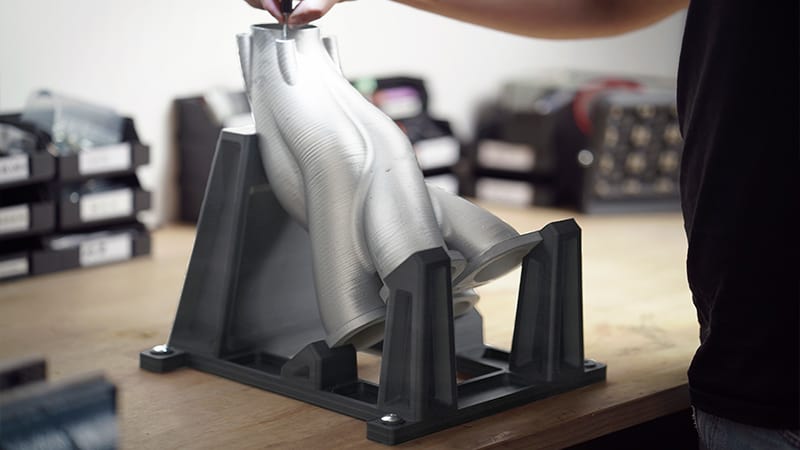
Used as tooling, fixtures, or functional housings
It is especially strong for:
Assembly jigs and fixtures
Test rigs and inspection tools
Enclosures and mounts
Cable guides and strain reliefs
End of arm tooling
Prototypes that are mechanically representative
Short run functional parts
These are not “nice to have” parts.
They directly affect production speed and reliability.
Why FDM makes sense economically:
Traditional manufacturing has a fixed cost problem. Tooling, setup, and programming make sense only when volumes are high and designs are frozen.
FDM has almost no setup cost.
That means:
One part costs almost the same as ten
Design changes are cheap
Iteration is fast
Risk is low
For many B2B applications, the part itself is not the expensive part. Waiting for it is.
If a missing fixture stops a production line, the cheapest part is the one you get today, not the one you get cheapest in four weeks.
Where FDM does not make sense:
FDM is not magic and it is not universal.
It is usually not the right choice when:
Tolerances are extremely tight
Surface finish is critical without post processing
Material requirements exceed thermoplastics
Volumes are very high and stable
Knowing where not to use FDM is just as important as knowing where to use it.
Why many companies outsource FDM instead of doing it in house:
Buying a printer is easy. Running it reliably is not.
In house FDM requires:
Machine calibration
Material handling and storage
Process tuning per material
Quality control
Operator time
Most companies do not want to become printing experts. They want parts that work.
Outsourcing FDM makes sense when:
Prints need to be reliable and repeatable
Engineering time is more valuable than machine time
Volume fluctuates
Multiple materials are needed
Lead time matters
A properly run print farm produces better parts than a printer sitting in a corner of an office.
What B2B customers should expect from a professional FDM service:
Not all printing services are the same.
A professional service should offer:
Material selection based on application, not availability
Proper calibration and process control
Consistent quality across batches
Clear pricing and lead times
Feedback on printability and design
This is the difference between “we can print it” and “this part will work”.
Why FDM fits modern manufacturing:
Modern manufacturing is fast, iterative, and flexible. FDM matches that reality.
It reduces dependency on long supply chains.
It lowers the cost of change.
It allows teams to test, adapt, and improve continuously.
That is why FDM keeps showing up on factory floors, not just in R&D labs.
FDM 3D printing is not a replacement for traditional manufacturing. It is a tool that fills the gap between idea and production, between problem and solution.
When used intentionally, it saves time, reduces risk, and keeps businesses moving.
If you have a part that needs to be produced quickly, customized, or iterated without the cost of tooling, FDM is often the right place to start.
We provide professional FDM 3D printing for B2B applications, from one off functional parts to short run production and manufacturing tooling.
Upload your model, choose your material, and get a real quote in minutes.