Frequently Asked Questions
Find quick answers to the most common questions about our materials, lead times, and ordering process.
What materials are available?
We print with industrial-grade materials including PLA, PETG, ABS, ASA, TPU, and PA12 — covering everything from simple prototypes to functional, high-strength components.
How do I get a quote?
Shoot us a message at [email protected] or use the contact form below. Attach your STL, STEP, or OBJ files and we’ll get back to you with pricing and lead time within 24 hours.
Do you offer bulk or production discounts?
Yes, we provide scaled pricing for batch runs, recurring orders, and long-term clients. Just mention your quantity when requesting a quote.
Where do you ship from?
All parts are produced and shipped directly from Schleswig, Germany. We deliver across the World with reliable, tracked shipping.
What’s your typical turnaround time?
Most orders are completed and shipped within 1–3 business days, depending on size and complexity. Larger production runs are scheduled individually.
Can I request custom materials or colors?
Absolutely, if you need a specific filament or color, we can order it in for your project. Just let us know in your quote request.
What tolerances can I expect?
Our FDM prints maintain ±0.2 mm dimensional accuracy, depending on part geometry and material. If you need tighter tolerances, just include that note in your quote request.
Do you offer resin or CNC machining?
Not yet, we currently focus entirely on FDM production to guarantee top reliability and speed. CNC and resin capabilities are planned for future expansion.
Can you help me improve my design before printing?
Yes. Every file is manually reviewed before printing, and we’ll reach out if we spot issues or ways to improve strength, fit, or surface finish. We don’t just print, we make sure your part works.
Turn your CAD files into real parts
Upload your files and get a fast, accurate quote for manufacturing. No back and forth. We review your design and handle production from start to finish.
Why Larger FDM Orders Fail (And How to Avoid It)
FDM 3D printing is very forgiving at low volumes.
At higher volumes, it isn’t.
Printing ten parts is mostly about getting a good print.
Printing hundreds or thousands of parts is about managing consistency, count, and quality.
Once quantities increase, the printer stops being the main challenge.
The process becomes the challenge.
When quantity increases, small mistakes multiply
At low volume, a small issue is annoying.
At higher volume, the same issue becomes expensive.
A miscount of a few parts no longer rounds out naturally.
A small defect no longer gets lost in the batch.
A minor inconsistency shows up again and again.
At this stage, printing “good parts” is not enough.
You need predictable output.
Part count becomes a real requirement
In larger orders, accuracy is not just about dimensions.
It is also about numbers.
When a customer orders hundreds or thousands of parts, the expectation is simple:
the count is correct.
That means production needs structure.
Not guessing, not approximating, not catching up at the end.
Clear tracking matters more than print speed.
Quality control stops being visual and becomes systematic
Checking every single part works at low volume.
It does not scale.
At higher quantities, quality control becomes about sampling and trend detection.
Instead of inspecting everything, you inspect at defined intervals.
This makes it possible to:
Catch issues early
Prevent entire batches from drifting
Keep quality consistent without slowing production
The goal is not perfection on one part.
The goal is repeatability across all parts.
Consistency beats optimization
One of the biggest mistakes in larger FDM orders is constant tweaking.
At small scale, tuning mid-print feels productive.
At larger scale, it breaks consistency.
Once production starts, stability matters more than improvement:
Same slicer settings
Same material batch
Same orientation
Same parameters
Consistency is what keeps hundreds of parts identical.
Why small parts scale well in FDM
Small parts are one of FDM’s strongest use cases.
They are:
Thermally stable
Easy to batch
Less sensitive to warping
Faster to recover if a failure happens
This makes them ideal for larger FDM orders, where yield and predictability matter more than raw size.
Why this is hard to manage in-house
Most companies don’t struggle with printing itself.
They struggle with everything around it.
Managing larger FDM orders requires:
Tracking output
Basic quality control structure
Process discipline
Operator time
That overhead grows quickly with volume.
This is why outsourcing FDM often makes sense once quantities increase.
Not because printing is hard, but because managing production takes focus.
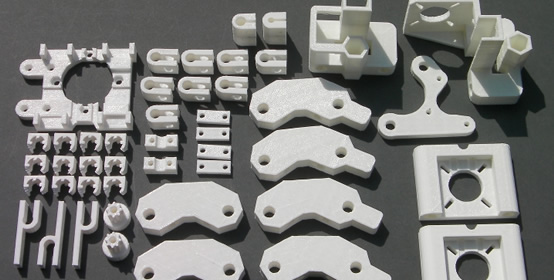
If you need small functional parts in the hundreds or thousands, FDM can scale well when it is run with the right production mindset.
We handle FDM production with repeatability, basic quality control, and predictable output.
You don’t have to manage any of it.
Upload your part and get a quote:
https://miloshevmachinery.com/quote