
Frequently Asked Questions
Find quick answers to the most common questions about our materials, lead times, and ordering process.
What materials are available?
We print with industrial-grade materials including PLA, PETG, ABS, ASA, TPU, and PA12 — covering everything from simple prototypes to functional, high-strength components.
How do I get a quote?
Shoot us a message at [email protected] or use the contact form below. Attach your STL, STEP, or OBJ files and we’ll get back to you with pricing and lead time within 24 hours.
Do you offer bulk or production discounts?
Yes, we provide scaled pricing for batch runs, recurring orders, and long-term clients. Just mention your quantity when requesting a quote.
Where do you ship from?
All parts are produced and shipped directly from Schleswig, Germany. We deliver across the World with reliable, tracked shipping.
What’s your typical turnaround time?
Most orders are completed and shipped within 1–3 business days, depending on size and complexity. Larger production runs are scheduled individually.
Can I request custom materials or colors?
Absolutely, if you need a specific filament or color, we can order it in for your project. Just let us know in your quote request.
What tolerances can I expect?
Our FDM prints maintain ±0.2 mm dimensional accuracy, depending on part geometry and material. If you need tighter tolerances, just include that note in your quote request.
Do you offer resin or CNC machining?
Not yet, we currently focus entirely on FDM production to guarantee top reliability and speed. CNC and resin capabilities are planned for future expansion.
Can you help me improve my design before printing?
Yes. Every file is manually reviewed before printing, and we’ll reach out if we spot issues or ways to improve strength, fit, or surface finish. We don’t just print, we make sure your part works.
Turn your CAD files into real parts
Upload your files and get a fast, accurate quote for manufacturing. No back and forth. We review your design and handle production from start to finish.
Filament Moisture Problems and How To Fix Them
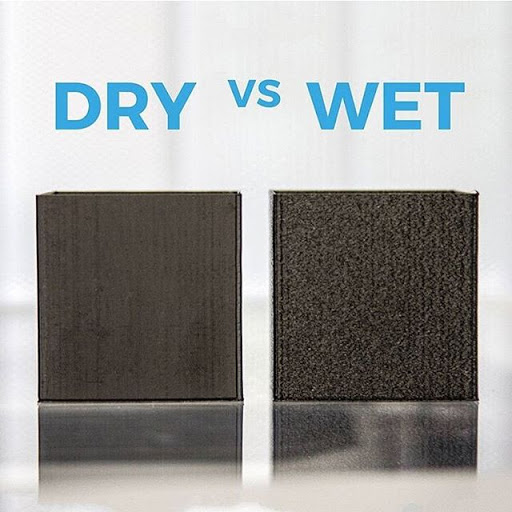
Moisture ruins more prints than bad slicer settings. Most people blame temperatures, retraction, or speed when a print looks rough, but wet filament is usually the real cause. Once the material absorbs water, the melt expands, pops, and throws off the entire extrusion process.
You get stringing, bubbles, weak layers, and a dull surface. In extreme cases, the filament hisses at the nozzle because steam is literally bursting out of it.
Why Filament Absorbs Moisture
PLA, PETG, ABS, and especially nylons pull moisture from the air. Some materials take longer than others, but every open spool will eventually get wet. Once that happens, the nozzle cannot extrude a stable line anymore, and the print loses strength fast.
The problem starts at the layer interface. Steam creates tiny voids. Even if the part looks fine on the outside, the mechanical strength can drop drastically.
How To Store Filament Correctly
For everyday materials, keep your filament below 30 to 40 percent humidity. The easiest way is to use airtight storage with silica gel. Replace or recharge the desiccant regularly, because it saturates quickly.
If you run a print farm or print often, use a dedicated dry box that keeps filament in a low humidity environment while feeding directly into the printer.
How To Dry Filament
If the filament crackles during extrusion, it is wet. Dry it before printing.
Here are proven temperature ranges:
PLA: 45 to 55 degrees
PETG: 50 to 55 degrees
ABS: around 60 degrees
Nylon: 70 to 80 degrees and longer drying time
Most materials need four to six hours. Nylon often needs more.
Dryers work best when they run during the entire print. Moisture can come back quickly, especially with hygroscopic materials like nylon and TPU.
How To Prevent Moisture Getting In Again
Drying a spool once is not enough if you leave it out in the open. The filament will absorb water again within hours.
Keep these rules simple:
Store every spool airtight when not in use
Keep desiccant refreshed
Dry the filament right before printing if it sat out for a while
Use an active dry box during long prints
If you print functional parts, do not skip the drying step. Moisture affects strength more than surface quality, and failure usually starts inside the layers long before it becomes visible.
Clean, strong prints do not only come from perfect slicer settings. They come from dry material, proper storage, and stable temperatures. Get moisture under control, and most of your extrusion issues disappear instantly.