
Engineering Material Selection Guide for FDM 3D Printing
How to choose the right FDM material - PLA, PETG, ABS, ASA, TPU, PA12 and PA12-CF - based on environment, mechanical load and production goals.
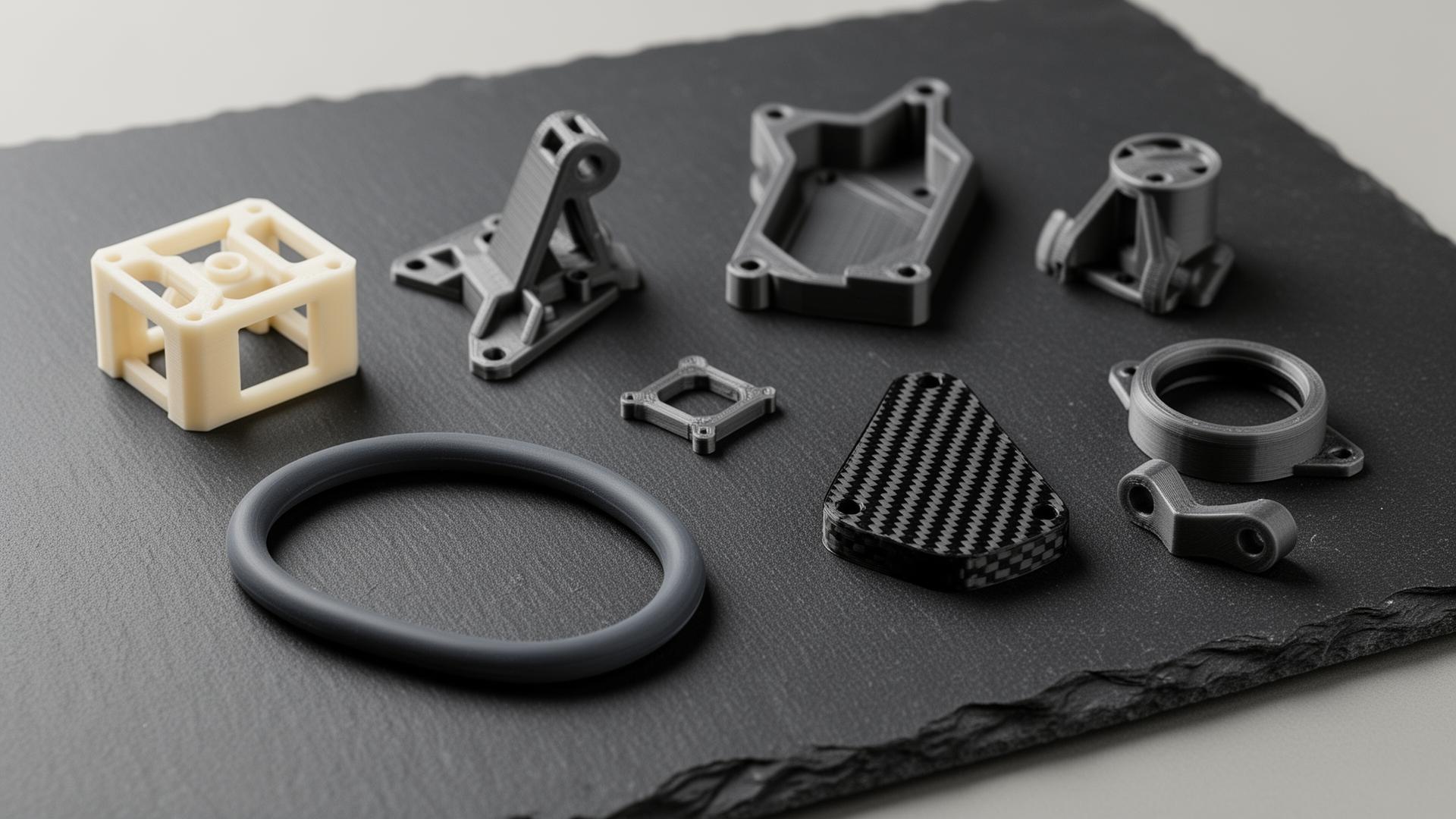
Choosing the right material is one of the most important decisions in any FDM 3D printing project.
Most print failures, premature part failures and unnecessary costs are not caused by poor print quality. They start with the wrong material selection.
A part designed for PLA may fail outdoors. A component printed in TPU may deform under load. A nylon part may perform perfectly mechanically but absorb moisture and change dimensions over time.
The best material is not the strongest material. It is the material that matches the environment, mechanical requirements and production goals of the application.
This guide explains where the most common engineering materials fit, what their strengths are and when they should be avoided.
Start with the environment
Before looking at mechanical properties, ask three questions:
- Will the part be exposed to heat?
- Will the part be exposed to sunlight or weather?
- Will the part experience continuous mechanical load?
The answers eliminate many material options immediately. A material that works perfectly indoors may fail after a few weeks outside. A material with excellent strength may soften when exposed to elevated temperatures. Material selection is often less about what a material can do and more about what conditions it can survive.
PLA
PLA remains one of the most widely used FDM materials for a reason. It prints easily, produces excellent surface quality and is cost-effective for visual prototypes, fit checks, fixtures and non-critical components.
- Best for: visual prototypes, concept models, fit and assembly tests, display parts, low-load fixtures.
- Avoid when: parts are exposed to sunlight, temperatures may exceed 50-60 °C, or long-term durability is required.
PETG
PETG fills the gap between PLA and engineering-grade materials. It offers improved impact resistance, better chemical resistance and significantly better environmental durability than PLA while remaining relatively easy to print.
- Best for: functional prototypes, industrial brackets, protective covers, general-purpose production parts, light outdoor use.
- Advantages: good chemical resistance, improved impact strength, better temperature resistance than PLA, lower warping risk than ABS.
ABS
ABS has been used in manufacturing for decades. Compared to PETG, it offers better heat resistance and easier post-processing while maintaining good toughness.
- Best for: machine covers, electronic enclosures, automotive interior parts, functional production components.
- Advantages: good heat resistance, easy machining and sanding, strong and durable, suitable for larger production runs.
ASA
ASA is often described as outdoor ABS. Mechanically similar to ABS, but with significantly better UV resistance and weather stability.
- Best for: outdoor enclosures, sensor housings, signage, external machine parts, automotive exterior components.
- Advantages: excellent UV resistance, good weather resistance, strong mechanical properties, suitable for long-term outdoor use.
TPU
Not every part needs to be rigid. TPU provides flexibility, impact absorption and wear resistance that rigid materials cannot achieve.
- Best for: seals, gaskets, protective covers, vibration dampers, flexible connectors.
- Advantages: flexible and elastic, excellent impact resistance, good abrasion resistance, long service life under repeated movement.
PA12 (Nylon)
PA12 is one of the most capable engineering materials available for FDM. It combines strength, toughness, fatigue resistance and wear resistance in a single material.
- Best for: mechanical components, functional assemblies, production tooling, load-bearing brackets, industrial fixtures.
- Advantages: high toughness, excellent wear resistance, good fatigue performance, suitable for demanding industrial use.
PA12 Carbon Fiber
PA12-CF combines nylon with carbon fiber reinforcement. The result is a material that delivers significantly higher stiffness while keeping many of the benefits of nylon.
- Best for: structural components, robotics, lightweight mechanical assemblies, end-use industrial parts, manufacturing equipment.
- Advantages: high stiffness, excellent dimensional stability, reduced weight, professional engineering appearance.
Quick material selection summary
- Lowest cost prototype - PLA
- General functional part - PETG
- Heat resistance - ABS
- Outdoor exposure - ASA
- Flexible component - TPU
- Tough engineering part - PA12
- High stiffness, low weight - PA12-CF
The most common material selection mistake
Many projects start by asking: "What is the strongest material?" The better question is: "What conditions will this part operate in?"
A material that survives outdoors for five years is stronger for that application than a material with higher tensile strength that cracks after six months. Engineering material selection is about matching performance to requirements, not simply choosing the material with the highest numbers on a datasheet.
If you'd like help matching a material to your part, send us the operating conditions and we'll recommend the right choice.